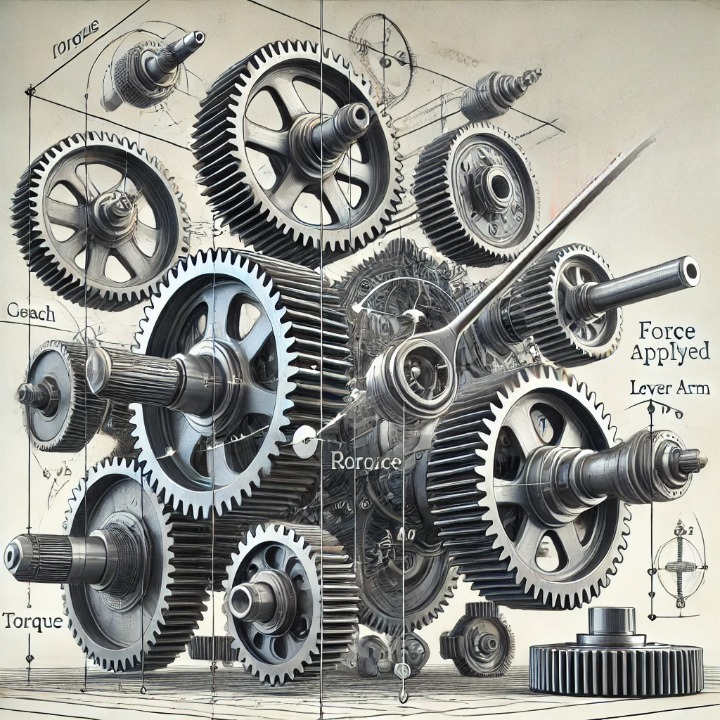
Torque is a fundamental concept in physics and mechanics that refers to the tendency of a force to rotate an object around an axis, pivot, or fulcrum. It is often called “rotational force” and plays a critical role in understanding how things like engines, machines, and even the human body function when rotation or turning is involved.
Components of Torque
Torque (𝜏) is mathematically expressed by the equation:
𝜏 = 𝐹×𝑟×sin(𝜃)
Where
𝜏 = τ is the torque.
𝐹 = F is the force applied.
𝑟 = r is the distance (or lever arm) from the axis of rotation to the point where the force is applied.
𝜃 = θ is the angle between the force vector and the lever arm.
This equation tells us that torque depends on three things:
The force applied (F): The greater the force, the larger the torque.
The angle (θ): The most torque is generated when the force is applied perpendicular to the lever arm (i.e.,θ=90o, where sin(90o) = 1). If the force is applied at an angle, the effective force contributing to rotation decreases.
The distance (r): The farther from the axis you apply the force, the greater the torque. This is why using a longer wrench makes it easier to turn a bolt.
Conceptual Example: Wrench on a Bolt
Imagine you’re using a wrench to tighten a bolt. The wrench is like a lever, and you apply force at the end of the handle. The bolt is the axis of rotation. The longer the handle (lever arm), and the more force you apply, the more torque you generate to turn the bolt. If you push straight down, perpendicular to the wrench, you get the maximum torque. But if you push at an angle, less of your force contributes to turning the bolt.
Positive and Negative Torque
Positive Torque: Causes the object to rotate counterclockwise.
Negative Torque: Causes the object to rotate clockwise.
The direction of torque depends on the direction of the applied force and how the object rotates around the axis.
Real-World Applications of Torque
Automobiles: In vehicles, torque is crucial because it determines the rotational force the engine generates to turn the wheels. More torque generally means better acceleration, especially from a standstill.
Door Handles: When you push a door open, you’re applying torque. The force you exert on the handle, combined with the distance of the handle from the hinges (the axis), generates torque to swing the door.
Sports: In activities like baseball or golf, athletes generate torque by twisting their bodies. The faster they rotate their hips and torso (longer lever arms), the more torque they can transfer to the bat or club, resulting in more powerful swings.
Units of Torque
Torque is typically measured in Newton-meters (Nm) in the metric system. This represents the amount of torque created when a force of one Newton is applied one meter from the pivot point. In the imperial system, torque is often measured in pound-feet (lb-ft).
Moment of Inertia and Angular Acceleration
Torque is related to angular acceleration, just as force is related to linear acceleration in Newton’s second law. The rotational equivalent of Newton’s law is:
𝜏 = 𝐼⋅𝛼
Where:
I is the moment of inertia (the rotational equivalent of mass), which depends on how mass is distributed around the axis.
α is the angular acceleration (how quickly the object’s rotational velocity is changing).
In essence, just as a larger mass requires more force to accelerate, a larger moment of inertia requires more torque to accelerate rotationally.
Summary
Torque is rotational force.
It depends on the force applied, the distance from the pivot, and the angle of application.
It’s measured in Newton-meters (Nm) or pound-feet (lb-ft).
Torque is essential in understanding mechanics, from simple machines to advanced engines and robotics.


Leave a Reply