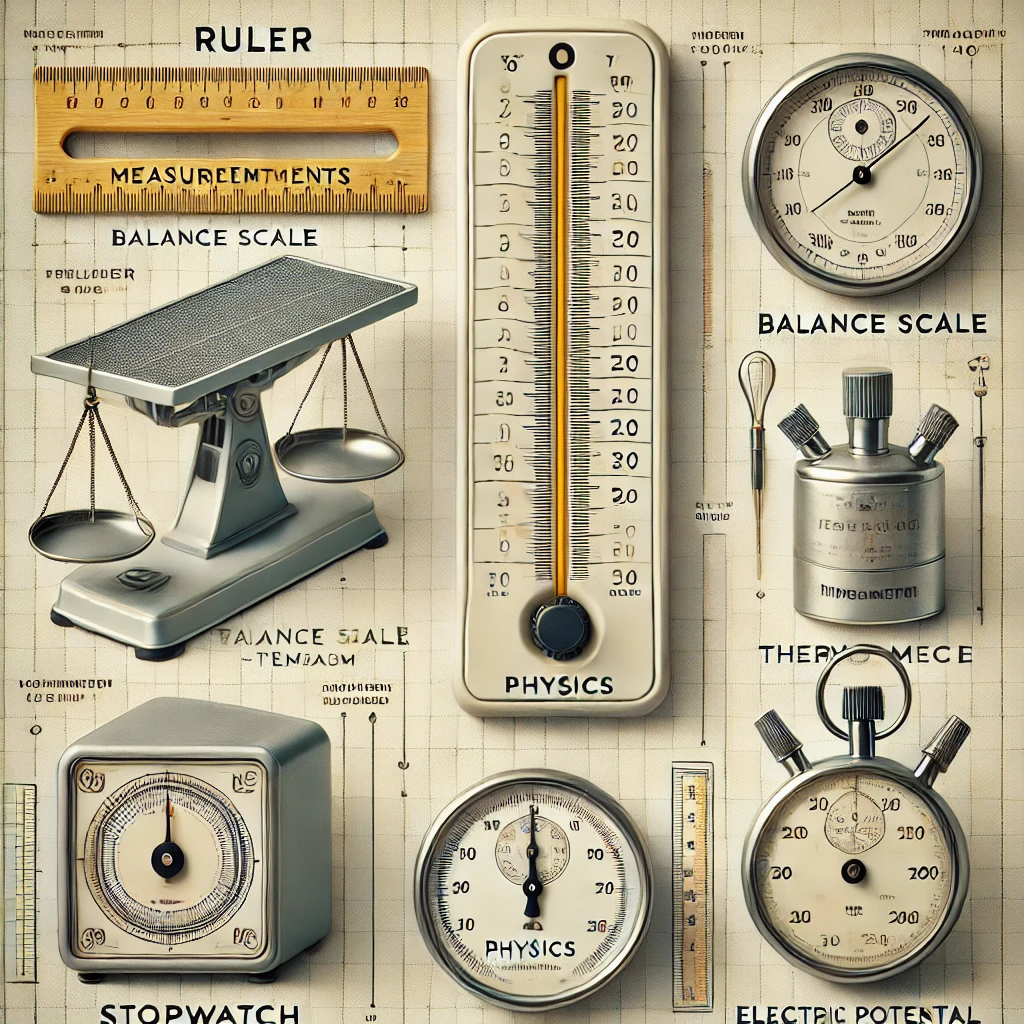
Measurements in physics are essential for quantifying physical quantities and understanding the laws of nature. They provide a way to express how much of a particular quantity is present, whether it’s length, time, mass, or something more complex like electrical charge or temperature. Here’s an overview of key concepts related to measurements in physics:
1. Physical Quantities
- Fundamental Quantities: These are basic physical quantities that cannot be defined in terms of other quantities. The International System of Units (SI) defines seven fundamental quantities:
- Length (meter, m)
- Mass (kilogram, kg)
- Time (second, s)
- Electric Current (ampere, A)
- Temperature (kelvin, K)
- Amount of Substance (mole, mol)
- Luminous Intensity (candela, cd)
- Derived Quantities: These are quantities derived from the fundamental ones, such as velocity (m/s), acceleration (m/s²), force (newton, N), and energy (joule, J).
2. Units of Measurement
- SI Units: The International System of Units (SI) is the standard system used in science. It ensures consistency and clarity in measurements. For example, distance is measured in meters (m), and time in seconds (s).
- Non-SI Units: There are other units in use, such as miles, pounds, and gallons, but they are not standardized in scientific contexts.
3. Measurement Instruments
- Rulers and Calipers: Used for measuring length.
- Balances: For measuring mass.
- Stopwatches: For measuring time.
- Thermometers: For measuring temperature.
- Voltmeters and Ammeters: For measuring electrical quantities.
4. Precision and Accuracy
- Precision: Refers to the consistency of repeated measurements. A measurement is precise if it yields similar results under the same conditions.
- Accuracy: Refers to how close a measurement is to the true value. An accurate measurement is close to the actual value being measured.
- Uncertainty: Every measurement has an associated uncertainty, reflecting the limitations of the measuring instrument and the process. It is usually expressed as a range (e.g., 5.0 ± 0.1 cm).
5. Significant Figures
- Significant figures are the digits in a number that contribute to its precision. The rules for determining significant figures help in expressing measurements with the appropriate level of precision.
6. Dimensional Analysis
- Dimensional analysis is a technique used to check the consistency of equations by ensuring that the dimensions (e.g., length, mass, time) match on both sides of the equation.
7. Error Analysis
- Errors are the differences between measured values and the true values. They can be classified as:
- Systematic Errors: Consistent, repeatable errors caused by faulty equipment or experimental design.
- Random Errors: Unpredictable variations that arise from factors like fluctuations in temperature or human error.
8. Significance of Measurement in Physics
- Measurement is crucial in physics because it allows scientists to test hypotheses, develop theories, and establish laws. Without accurate and precise measurements, scientific progress would be impossible.
These concepts form the foundation of experimental physics and are vital for any study involving physical quantities.


